martes, 8 de enero de 2013
The Eric Clapton story
Eric Clapton, thought by many to be the preeminent guitar authority in the world, is returning to the stage in the summer of 2006. His story is one that relates directly to the decades of timeless music he has produced, and Clapton is revered by fans of several generations. His life is one of struggle and sadness, and his music is seen by many of his fans as his personal triumph over his circumstances.
Early Life
Clapton was born in 1945 in England, although he didn’t really know who his parents were until later in childhood. His father was a Canadian service man who went back to Canada after World War II, and his natural mother left soon thereafter to join him. Eric was left to be raised by his grandparents, who he thought were his real parents until he was nine years old. Clapton knew his real mother as his sister, as his grandparents wanted to shield him from the stigma that came with being an “illegitimate” child.
Clapton was first inspired by music as a young teenager when he watched Jerry Lee Lewis perform on television, and his life-long love of the blues was born that day. He attended school with the intent on becoming a stained glass designer was derailed when he was expelled at 17 for playing his guitar in class. Despite what was seen as a setback at the time, the incident propelled Clapton into music full time.
Early Career
Clapton proceeded to work a series of low-end jobs while continuing to learn and play the blues with his guitar. In 1963, he joined a band called the Yardbirds, which just happened to boast of three enormously popular guitarists - Clapton, Jimmy Page and Jeff Beck. The band was an instant smash hit, and they were known for their bluesy style and riveting guitar melodies. However, Clapton became disillusioned with the band’s progression towards mainstream rock and roll, and left the band in 1965.
Clapton spent the next year making the band the Bluesbreakers extremely popular, but in 1966, he decided to form his own band, naming it Cream.
Reaching Potential
Cream was one of the most recognizable and loved bands in the world, and every one of their albums was a huge hit. Cream was mentioned in the same breath as the Rolling Stones and the Beatles, and the trio recorded three albums before deciding to put together a farewell cut entitled Goodbye in 1969. There were many reasons for the band’s break up, but drug abuse and clashing egos were seen as the primary reasons.
Later that year, Clapton became a member of rock’s first “super group” when he teamed with Steve Winwood, Ric Grech and Ginger Baker. Although the band released only one album which was named after the band, Blind Faith climbed to number one on the North American Billboard album charts, and the work is still selling well to this day.
Going Solo
After all of his experience in highly successful bands, Clapton decided to strike out on his own, and this would prove to be an extremely wise decision. However, Clapton first had to get past his drug addiction, which was no small task. Once he had, however, he got right back into what he loved most, and released an album entitled 461 Ocean Boulevard in 1974. The album included a cover of Bob Marley’s I Shot the Sheriff, which not only experienced chart success, but brought exposure to the world of reggae that was seen as “the” boost to the genre in general.
In the past 30 years, Clapton has released 15 studio albums which have contained songs that are considered by many to be anthems more than singles, including such mega-hits as "Knockin' on Heaven's Door," "Lay Down Sally," "Cocaine" and "Wonderful Tonight."
Bringing It All Together
The result of Clapton’s work goes beyond millions of records sold and tens of millions of loyal fans. He is the only artist to be inducted into the Rock and Roll Hall of Fame three times, has won several Grammy Awards and is known for his guitar skill in every country in the world. He has never lost his love for the blues, and continues to thrill crowds with his heart-felt renditions of his and other songs that were written over the decades, and everyone who has a chance to see him live considers it a privilege and an honor.
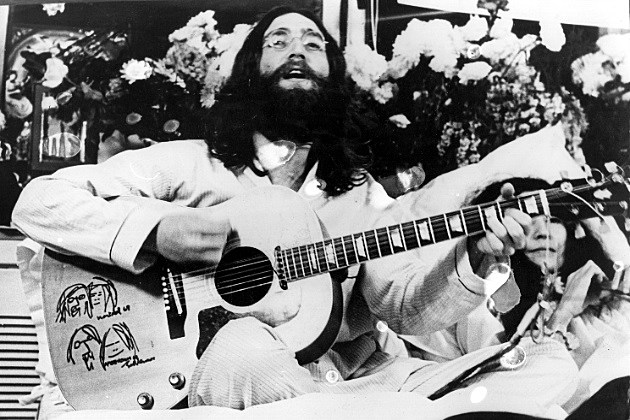
New Film ‘Imagines’ a Life Inspired by John Lennon
Hollywood's a-buzzin' with news about a new film called "Imagine" which is set to star Al Pacino, Julianne Moore and Jeremy Renner. The movie, scheduled to start filming this Spring, was inspired by the true story of an aspiring folk musician who received a letter from John Lennon 34 years after it was written.
Screenwriter and Director Dan Fogelman says he read an article on the internet from 2010 about Steve Tilston, a British musician, who was interviewed by a music magazine in 1971. In the interview, Tilston explained that he was worried about becoming a rich and famous musician and as a result, losing his creativity.
John Lennon read the interview and wrote a letter to Tilston and the journalist that interviewed him offering encouragement and help. Lennon reassured Tilston that "Being rich doesn't change your experiences in the way you think" and even included his home phone number. The letter was signed "Love John and Yoko" and sent to the magazine offices.
However, Tilston did not see the letter until 34 years later. The letter was intercepted and wound up in the hands of a memorabilia collector. In 2005, Tilston was contacted by the collector and shown the letter. (Note: A copy of the letter can be seen in the 2012 book, The John Lennon Letters)
It turns out that Tilston never had to worry about the effects of being wealthy. But screenwriter Dan Fogelman decided to explore what would happen in this situation if a musician like Tilston had become rich.
In a recent interview, Fogelman explained: "I thought, 'What about a guy whose life had gone completely off the rails, as he feared. He sold out musically and abandoned his family, and then gets this letter that could have course-corrected him, all the way back then. And he goes on this redemption quest in his 60′s.'”
In the film, Al Pacino will portray a fictional musician, Danny Collins, who discovers a letter years later written to him from John Lennon. As a result, Collins is motivated to make changes in his life which include reconnecting with his son, played by Jeremy Renner.
Fogelman has written the screenplays for films like "Crazy, Stupid Love" and most recently, "The Guilt Trip" starring Barbra Streisand. "Imagine" will be his directorial debut.
lunes, 7 de enero de 2013
The 50 Best Rolling Stones Songs by Duffy part. 2
11. Ruby Tuesday
It’s a song so enduring it’s got a national restaurant chain named after it. But Keith Richards’ ode to a free-spirited flame who’s impossible to pin down is far tastier than anything you’ll find on the menu.
12. Start Me Up
You won’t find much of The Rolling Stones’ post-Some Girls output on this list, but this 1981 Tattoo You track ranks among their all-time greats. Keith Richards’ iconic opening riff alone is enough to warrant its inclusion, and Mick’s howls of “you make a grown man cry” (not to mention some of the more suggestive lyrics) will get anyone revved up
13. Moonlight Mile
As Sticky Fingers comes to a close with “Moonlight Mile,” this lushly arranged ballad lasts for roughly six minutes. Most Stones fans wouldn’t mind it continuing forever. Created after Mick Jagger and Mick Taylor hashed out the song during an all-night session, Jagger takes the lead on acoustic guitar on record, while adding strings to top it off. After Sticky Fingers’ particularly controversial and riff-heavy focus, this song offers a chance to reflect on the tyranny of distance and madness on the road.
14. Rocks Off
Exile On Main St.‘s opening track perfectly sets the tone for the rest of what would become forever lauded as the band’s magnum opus. It sounds like a party—driving horns, some killer licks and Jagger’s sneering vocals all tossed together to perfection—but, penned at the height of Keith Richards’ heroin addiction, it hints at something darker. Lyrics like “I can’t even feel the pain no more” and “I want to shout but I can’t hardly speak” are revealing, while “The sunshine bores the daylights out of me” fits right in with the rest of our favorite smartasses’ devil-may-care catalog.
15. Loving Cup
“Loving Cup” is yet another example of the unique magic contained within Exile on Main St. It was a disorganized mess of a recording process, one with full-time members missing some sessions altogether and other non-members jumping in spontaneously. It somehow not only worked out, but also swelled to become the ultimate diamond in the rough. “Loving Cup” is one of those tracks to arise from the depths of Southern France.
16. Jumpin’ Jack Flash
One of the Stones’ most recognizable hits, “Jumpin’ Jack Flash” takes the blues that acted as such a strong early influence for them and turns it on its head. Sure, the song’s protagonist “was raised by a toothless, bearded hag” and “schooled with a strap right across [his] back,” but the track dismisses his prior suffering in favor of a simple, much sunnier outlook: “It’s all right now, in fact it’s a gas.”
17. Wild Horses
Featuring the likes of Gram Parsons and Jim Dickinson, “Wild Horses” has become one of the most frequently covered songs in rock ’n’ roll history. Many believe that Jagger wrote the lyrics about Marianne Faithfull, but he’s refuted that on numerous occasions. Nevertheless, it’s one of the band’s more intimate and poignant songs throughout their five decades together.
18. Shine A Light
On “Shine A Light,” Jagger, Richards and the rest of The Rolling Stones are firing on all cylinders, taking the sprawling Exile on Main St. to its final climax. The album is undoubtedly a gospel-tinged affair—just look at number five on this list for another example—but it’s Exile’s 17th track that illuminates the album in all its sprawling glory.
19. The Last Time
The Verve had to pay big when their hit “Bitter Sweet Symphony” was found to be a little too similar to this classic Stones track in 1997, but it’s easy to see why they’d be tempted to lift its catchy hook.
20. Honky Tonk Women
“Honky Tonk Women” was about as Western as the Stones ever ventured, yet it struck a perfect balance, combining classic country influences into their conventional blues rock. Between the song’s signature cowbell (played by producer Jimmy Miller) and Mick Taylor’s reworking of a traditional ’30s era song along the lines of Hank Williams and Jimmie Taylor, the British group never sounded more American.
To be continue ....
Suscribirse a:
Entradas (Atom)